PCIe Gen5 Validation: Faster Speeds, Smaller Margins
PCIe Gen5 has become a critical interconnect for AI servers, storage systems, networking equipment, and high-performance computing platforms. Operating at 32 GT/s, it delivers twice the bandwidth of PCIe Gen4 while sharply reducing the available signal margins. As data rates climb, validation grows considerably more complex: engineers must evaluate signal integrity, equalization behaviour, jitter performance, protocol compliance, power integrity, and interoperability across many devices and platforms. Even minor impairments can produce compliance failures, unstable links, or unexpected down-training.
At Primeasure, we support semiconductor, datacentre, and embedded-systems customers across India who are working through exactly these challenges. The Teledyne LeCroy oscilloscopes and PCIe compliance software we supply sit at the centre of most Gen5 validation benches. This article walks through the most common PCIe Gen5 validation challenges and how a modern transmitter and receiver test setup helps engineering teams find and resolve them efficiently.
Signal Integrity Challenges in PCIe Gen5
At 32 GT/s, signal integrity is one of the primary factors affecting PCIe performance. PCB discontinuities, connector losses, impedance mismatches, and crosstalk can significantly reduce eye openings and undermine link reliability. Common symptoms include:
- Eye closure
- Increased bit error rates
- Link instability
- Reduced performance
- Compliance test failures
How Engineers Address Signal Integrity Issues
High-bandwidth oscilloscopes are essential for evaluating eye diagrams, insertion loss, return loss, equalization behaviour, and jitter. But collecting measurements is only part of the challenge — engineers also need tools that accelerate root-cause analysis and compliance validation. Teledyne LeCroy's PCIe compliance and analysis platform combines oscilloscope measurements with automated PCIe-specific workflows, letting engineers quickly determine whether an issue originates in the transmitter, receiver, or channel. Automated eye analysis, jitter characterization, and compliance testing reduce debug cycles while improving measurement consistency.
PCIe Gen5 Equalization and Link Training Debugging
PCIe Gen5 relies heavily on transmitter and receiver equalization to compensate for channel loss. During Link Training and Status State Machine (LTSSM) operation, devices dynamically negotiate equalization settings to establish a reliable connection. When equalization does not converge correctly, engineers may see:
- Failed link initialization
- Unexpected down-training
- Reduced lane widths
- Intermittent connectivity
- Lower-than-expected throughput
How Engineers Debug Equalization Issues
Equalization failures are often hard to diagnose because the root cause can be hidden inside training sequences and coefficient exchanges. Protocol-analysis tools provide visibility into LTSSM transitions, equalization negotiations, recovery states, and training events. Combined with oscilloscope-based signal integrity measurements, engineers gain a complete view of both protocol and physical-layer behaviour — helping validation teams isolate whether the issue stems from channel conditions, equalization settings, firmware behaviour, or implementation-specific interoperability.
Jitter Analysis and PCIe Gen5 Compliance Testing
As signalling speeds rise, timing margins become increasingly sensitive to jitter. Excessive random jitter, deterministic jitter, clock noise, or power-related disturbances can all drive compliance failures. A system can appear functionally stable during normal operation yet still fail formal PCI-SIG transmitter compliance testing.
How Engineers Accelerate Compliance Validation
Understanding the source of jitter requires more than measuring total jitter. Engineers must separate the contributions of random jitter (RJ), deterministic jitter (DJ), periodic jitter (PJ), and duty-cycle distortion (DCD). Teledyne LeCroy's PCIe compliance solutions automate transmitter characterization through guided workflows that perform jitter decomposition, eye measurements, equalization verification, and compliance testing. Automated test execution and reporting simplify validation while delivering detailed insight into failures and margin limitations. Running pre-compliance testing early in development lets teams catch issues before formal PCI-SIG certification, reducing project risk and shortening validation schedules.
Power Integrity Challenges in PCIe Gen5 Systems
Power integrity is frequently overlooked during PCIe validation, yet it directly impacts transmitter performance, clock-generation circuits, and equalization behaviour. Voltage ripple, transient noise, and regulator instability often surface as jitter, link instability, or intermittent compliance failures.
How Engineers Correlate Power and Signal Behaviour
A comprehensive validation strategy includes power integrity measurements alongside traditional PCIe analysis. Correlating rail ripple and transient behaviour with signal integrity and protocol measurements helps engineers determine whether instability originates in the channel or the power delivery network — visibility that is especially valuable when troubleshooting intermittent failures that signal integrity analysis alone cannot explain.
PCIe Gen5 Transmitter and Receiver Validation
PCIe Gen5 compliance requires comprehensive validation of both transmitter (TX) and receiver (RX) performance. Transmitter testing focuses on signal quality and compliance metrics, while receiver testing verifies that devices can reliably recover data under stressed operating conditions.
Transmitter Validation
Transmitter validation typically includes eye-diagram analysis, jitter characterization, equalization verification, and compliance testing. Teledyne LeCroy's PCIe validation ecosystem lets engineers perform these measurements through automated workflows that simplify transmitter characterization and accelerate debug throughout the development cycle.
Receiver Validation
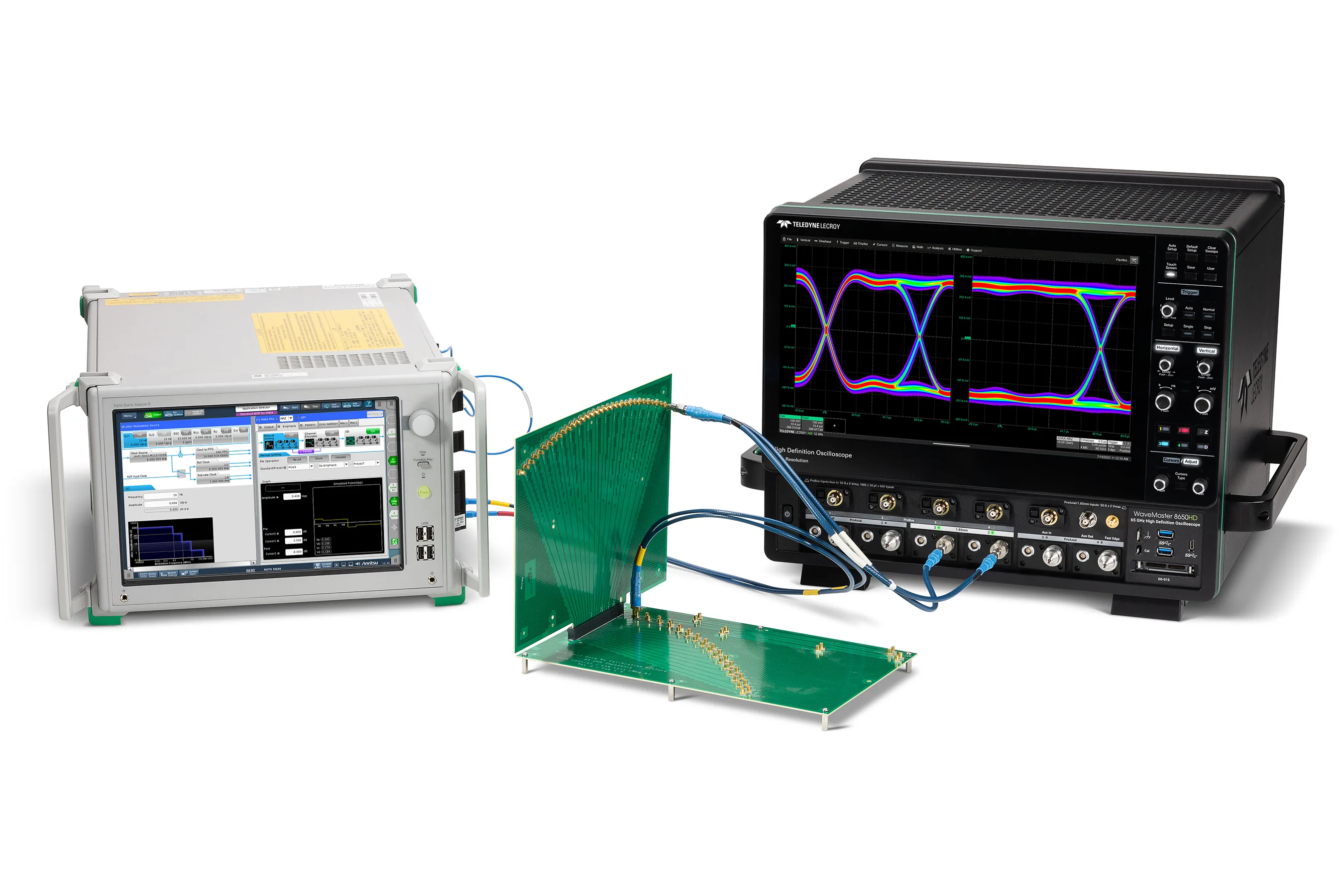
Receiver validation presents a different challenge. Engineers must deliberately introduce calibrated levels of jitter, noise, and channel impairment to verify receiver tolerance and margin. Anritsu's PCIe receiver test solutions are designed for this purpose — by generating stressed-eye conditions and supporting comprehensive receiver tolerance testing, they let engineers evaluate receiver robustness, identify margin limitations, and validate performance before formal compliance testing begins. Together, transmitter and receiver validation provide the complete picture required for successful PCIe Gen5 qualification.
PCIe Gen5 Interoperability Testing
A design that performs correctly in a controlled lab may still struggle when connected to third-party devices. Differences in firmware, equalization algorithms, and implementation details can expose unexpected interoperability issues — and these often emerge late in development, delaying deployment.
How Engineers Reduce Interoperability Risk
Testing across multiple root complexes, endpoints, cables, and operating conditions helps uncover compatibility issues before certification and deployment. Combining interoperability testing with transmitter validation, receiver characterization, and protocol analysis gives engineering teams greater confidence that designs will operate reliably across diverse real-world environments.
Primeasure Field Tip
We always reserve a second oscilloscope channel to monitor a reference clock or power rail during Gen5 transmitter testing. A surprising share of "transmitter" failures turn out to be clock jitter or supply droop. Catching those early on a Teledyne LeCroy scope saves days on the debug bench.
Frequently Asked Questions About PCIe Gen5 Validation
What is PCIe Gen5 validation?
PCIe Gen5 validation is the process of verifying that a design meets performance, signal integrity, protocol, interoperability, and compliance requirements while operating reliably at 32 GT/s.
What causes PCIe Gen5 compliance failures?
Common causes include excessive jitter, insertion loss, equalization issues, power integrity problems, protocol violations, and interoperability challenges.
What tools are used for PCIe Gen5 testing?
Engineers commonly use high-bandwidth oscilloscopes such as Teledyne LeCroy's PCIe platform, protocol analyzers, PCIe test equipment, and dedicated receiver test solutions to validate PCIe Gen5 designs and troubleshoot performance issues. A dedicated PCIe tester automates much of this PCIe compliance testing workflow, from eye measurements through final signoff.
Conclusion
PCIe Gen5 delivers the bandwidth modern AI, networking, and high-performance computing platforms demand, but reliable operation requires a comprehensive validation strategy. Signal integrity degradation, equalization failures, jitter sensitivity, power integrity concerns, and interoperability issues can all extend debug cycles if not addressed systematically. By combining Teledyne LeCroy's transmitter validation and compliance capabilities with Anritsu's receiver test solutions, engineering teams achieve complete PCIe Gen5 coverage, accelerate root-cause analysis, and build confidence before formal PCI-SIG compliance testing.
Validating PCIe Gen5 in India?
Primeasure supplies Teledyne LeCroy oscilloscopes, PCIe compliance software, automation, and calibration services across India. We can specify a complete Gen5 transmitter and receiver validation bench and train your engineering team to run it.
Explore Primeasure's Test & Measurement solutions available across India.
Speak with Our High-Speed Experts